Homewood was incorporated Oct. 29, 1926, from Rosedale, Edgewood and Grove Park. Its history, three National Register districts and places to visit.
Last checked Oct. 17, 2026. History on this page comes from the City of Homewood’s History of Homewood page and its centennial article, “Celebrating 100 Years of Homewood” by Barry Wise Smith. National Register listings come from the National Park Service.
Homewood turns 100 this month. The city was incorporated on Oct. 29, 1926, when three communities over Red Mountain from Birmingham, Rosedale, Grove Park and Edgewood, voted to merge under one name. The city’s centennial article calls it the first “over-the-mountain” city.
Visit and learn more
- Self-guided driving tour: 16 audio and text stops across Homewood’s historic wards, free on the TravelStorys app, from the Homewood Historic Preservation Commission
- Homewood Public Library: 1721 Oxmoor Road, 205-332-6600
- Historic Preservation Commission: city page; Engineering and Zoning, 205-332-6800
- 100-year-old houses map: the city’s interactive map
How Homewood began
| Year | What happened |
|---|---|
| Mid-1820s | First settlers cross Red Mountain from Elyton, now Birmingham, into the valley |
| 1850s | Mining and the railroad bring more people |
| 1873 | A cholera epidemic in Birmingham sends people to buy land and build communities around the city |
| By 1911 | Edgewood has an electric railway to downtown Birmingham |
| By 1915 | Edgewood Lake, a man-made lake, is built |
| 1920 | Edgewood incorporates |
| 1926 | Hollywood incorporates; in September, Rosedale, Edgewood and Grove Park vote to merge as Homewood |
| Oct. 29, 1926 | Homewood’s incorporation date |
| 1929 | Homewood annexes Hollywood |
| 1940 to 1950 | Population rises about 75% |
| 1954 | The U.S. 31 pedestrian tunnel is built for children walking to Shades Cahaba Elementary |
| 1955 | Homewood annexes Oak Grove |
| 1959 | Voters defeat Birmingham’s first move to annex Homewood |
| 1966 | The Alabama Supreme Court voids a 1964 annexation vote; on Dec. 13, 65% vote against annexation |
| 1970 | Homewood starts its own school system, leaving Jefferson County’s |
| 1972 | The new Homewood High School opens |
Sources: the city’s history page, centennial article and U.S. 31 tunnel history.
The centennial article says historic Rosedale, championed by florist Theodore Smith, became a thriving African American community; Edgewood was developed by Stephen Smith and Troupe Brazelton; and Hollywood was the work of Clarence Lloyd. The city’s history page credits a local attorney, Charles Rice, with starting the 1926 movement to merge. The Great Depression and a polio epidemic that sickened 80 Homewood children hit the city hard before the World War II steel boom in Birmingham brought growth back.
In the 1980s, the Red Mountain Expressway and the annexation of more than 500 acres in West Homewood grew the city’s economic base. Homewood now covers 8.3 square miles, the centennial article says.
National Register of Historic Places
| Listing | Where | Listed | What the register records |
|---|---|---|---|
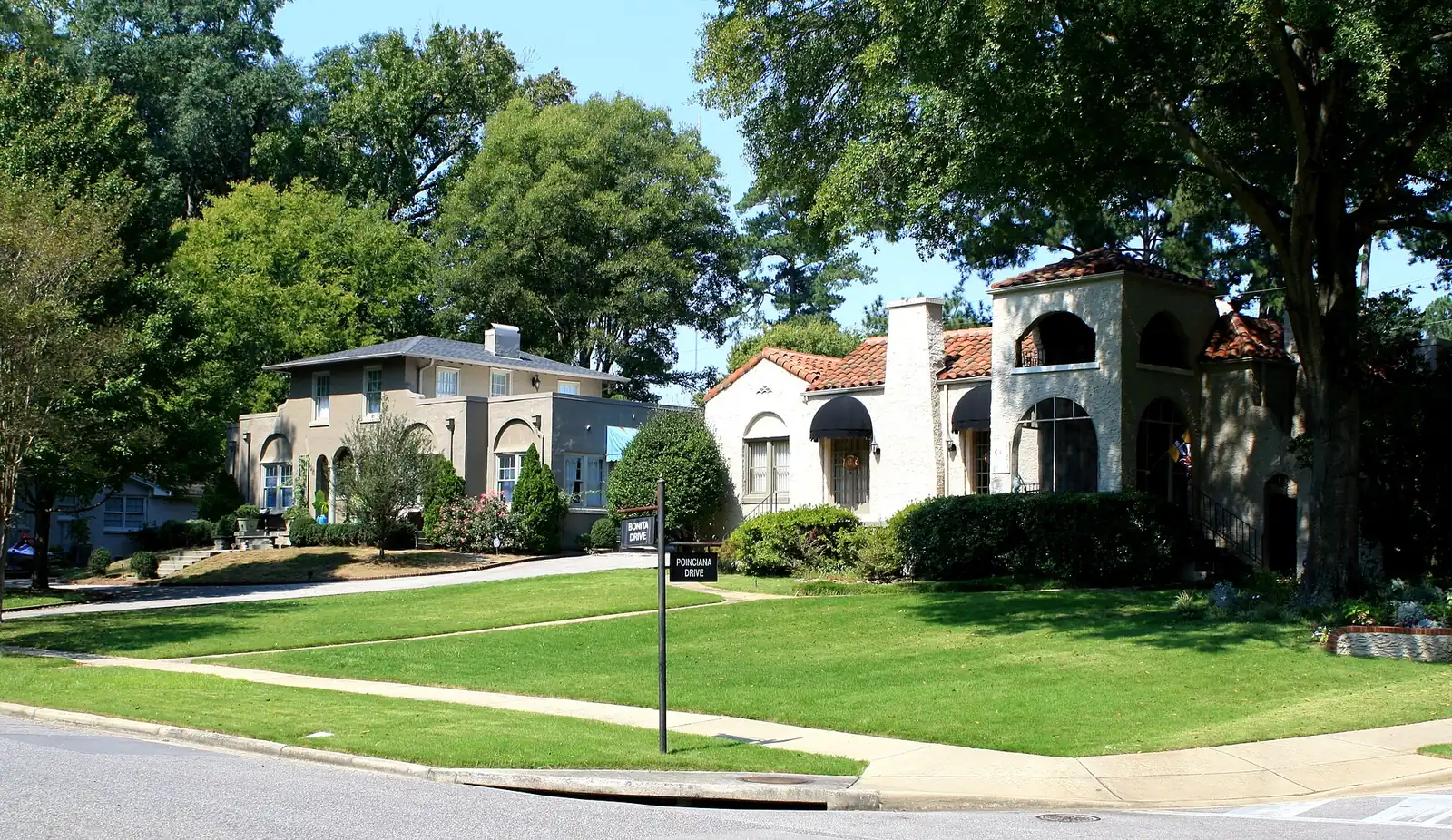
| Hollywood Historic District | Roughly bounded by U.S. 31, U.S. 280 and Lakeshore Drive | May 16, 2002 | Mission/Spanish Revival and Tudor Revival architecture; community planning |
| Rosedale Historic District | Roughly bounded by 25th Court South, Central Avenue, 27th Court South and Loveless/B.M. Montgomery Street | March 31, 2004 | Architecture and Black history, 1875 to 1974 |
| Rosedale Park Historic District | Roughly bounded by Woodcrest Place, 26th Avenue South, 18th Street South and 25th Court South | March 31, 2004 | Architecture and Black history, 1875 to 1949 |
| Lustron House on Columbiana Road | 430 Columbiana Road | Feb. 24, 2000 | A 1949 prefabricated steel Lustron house; the register files it under a Birmingham address |
Source: National Park Service, National Register of Historic Places records on NPGallery. The listing dates are the dates shown for each record.
Places to see
- The Hollywood neighborhood, between U.S. 31, U.S. 280 and Lakeshore Drive, for its Spanish Revival and Tudor Revival houses.
- Rosedale, around Central Avenue and 25th to 27th courts, which the city’s centennial article calls a thriving African American community.
- Edgewood Lake and the old Zelosophian Academy site, both stops on the city’s driving tour, along with the Pink House, the McDaniel House and Samford University.
- The U.S. 31 pedestrian tunnel, built in 1954 and now being renovated; the city says it stood in for a Chicago tunnel in the 1988 film “The Verne Miller Story.”
- Vulcan Park and Museum, on Red Mountain at 1701 Valley View Drive in Birmingham. The park, observation tower and museum are open 10 a.m. to 8 p.m. Sunday through Thursday and 10 a.m. to 9 p.m. Friday and Saturday, Vulcan Park and Museum says.
The centennial
The city has marked its 100th year with a gala, a brunch for former mayors and council members, a citywide picnic and a map of the city’s 100-year-old houses. On the birthday itself, Thursday, Oct. 29, 2026, a time capsule is buried at 4 p.m. at the Homewood Public Library. See the city’s centennial page and things to do this month.
Today’s city in numbers: see our population guide.
Frequently asked questions
When was Homewood, Alabama founded?
Homewood was incorporated on Oct. 29, 1926, after Rosedale, Edgewood and Grove Park voted to merge that year. The city marks its centennial on Oct. 29, 2026.
How did Homewood get started?
Settlers crossed Red Mountain from Elyton, now Birmingham, in the 1820s. Growth came after Birmingham’s 1873 cholera epidemic, when communities such as Rosedale, Grove Park, Edgewood and Oak Grove grew up south of the city.
What are Homewood’s historic districts?
Three are on the National Register of Historic Places: the Hollywood Historic District, listed May 16, 2002, and the Rosedale and Rosedale Park historic districts, both listed March 31, 2004.
When did Hollywood become part of Homewood?
Hollywood, incorporated in 1926, was annexed by Homewood in 1929, the city says. Oak Grove was annexed in 1955.
Did Birmingham ever try to annex Homewood?
Yes. Homewood voters defeated annexation in 1959. A 1964 vote was voided by the Alabama Supreme Court in 1966, and annexation failed again in a Dec. 13, 1966, election, with 65% voting against.
Have your say